

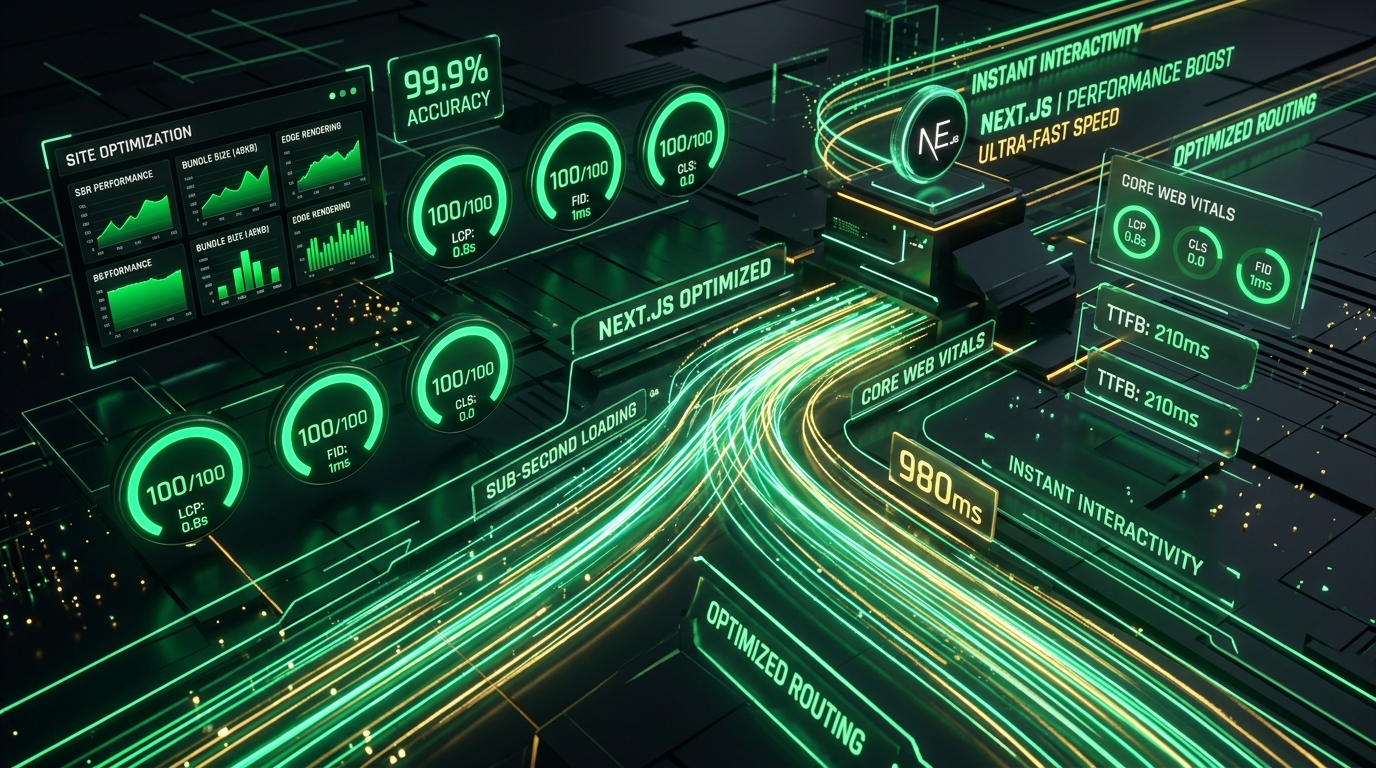
Delivering lightning-fast user experiences on the modern web directly correlates with increased user retention, higher conversion rates, and superior Google search rankings. With the evolution of the Next.js App Router, developers have powerful tools to achieve perfect 100 Lighthouse scores.
1. Largest Contentful Paint (LCP) Optimization
The hero section and main banner images are frequently the primary LCP elements. To minimize render delay:
- Use Next.js
<Image priority />: Instructs the browser to prioritize fetching the LCP image before non-critical assets. - Implement Modern Formats: Ensure images are served in AVIF or WebP with automatic responsive sizing (
sizes="(max-width: 768px) 100vw, 800px"). - Inline Critical CSS: Prevent render-blocking stylesheet waterfalls.
import Image from "next/image";

export function HeroBanner() {
  return (
    <div className="relative h-96 w-full overflow-hidden rounded-2xl">
      <Image
        src="/assets/hero-banner.webp"
        alt="Hero image"
        fill
        priority
        className="object-cover"
        sizes="(max-width: 1024px) 100vw, 1024px"
      />
    </div>
  );
}
2. Eliminating Interaction to Next Paint (INP) Bottlenecks
INP measures how responsive a page feels when users interact with buttons, menus, and inputs.
- Offload Heavy Calculations: Use Web Workers or asynchronous microtasks (
scheduler.yield()) for computation-heavy operations. - Minimize Hydration Cost: Keep client component boundaries as small as possible and utilize React Server Components for static layout blocks.
- Debounce Input Handlers: Prevent unnecessary re-renders during high-frequency keystrokes or scroll events.
3. SEO & Structured Schema Automation
A technically optimized web application must communicate effectively with search engine crawlers. Implementing dynamic XML sitemaps, OpenGraph image generation, and JSON-LD NewsArticle or BlogPosting schemas ensures high indexing fidelity across Google Search and Google News.
Key Takeaways
High-performance web architecture isn't an afterthought—it is a continuous discipline. Combining React Server Components, intelligent asset prefetching, and clean component isolation guarantees that your applications load instantly and stay blisteringly responsive.