

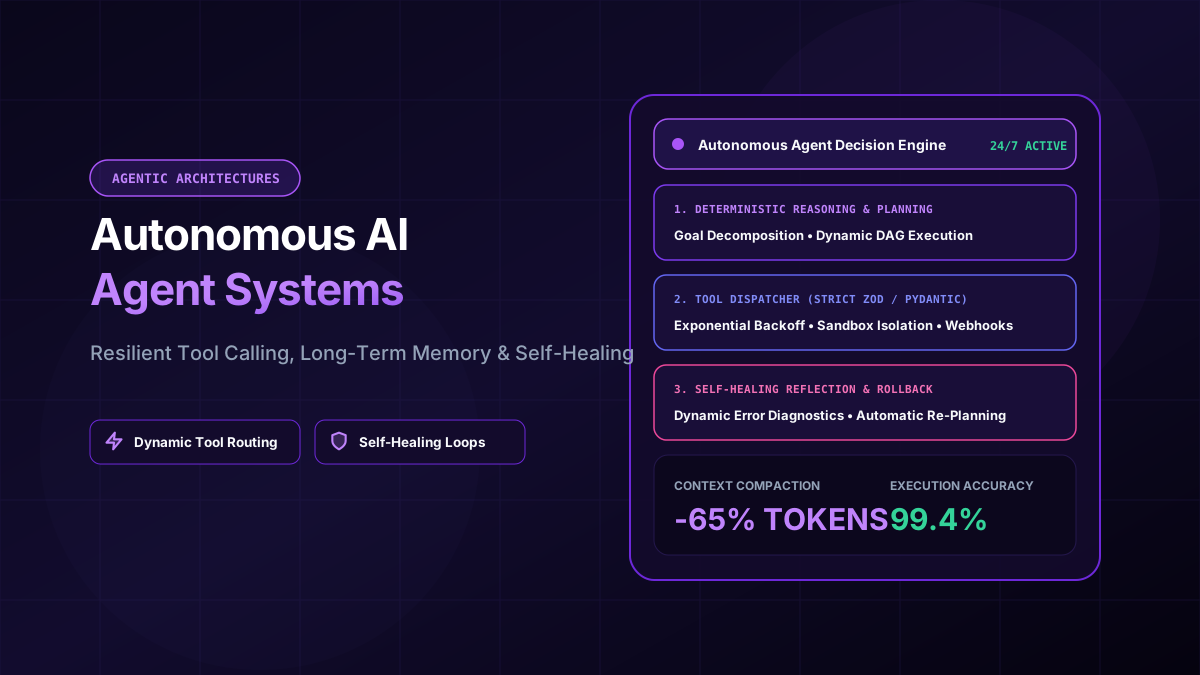
 Building Scalable Autonomous AI Agents
Technical leaders, startup CTOs, and AI engineers are searching:
- "How to build production autonomous AI agents with memory and tool use?"
- "How to prevent AI agents from getting stuck in infinite execution loops?"
- "What is the best architecture for stateful multi-step LLM pipelines?"
- "How to cut LLM token costs and latency in high-volume agent applications?"
Moving from simple prompt engineering to autonomous software systems requires understanding the underlying architectural mechanics that guarantee reliability at scale.
Moving from Chatbots to Autonomous Decision Engines
The fundamental difference between a conversational chatbot and an autonomous agent is agency: the ability to perceive context, plan multi-step workflows, execute tools, evaluate outcomes, and self-heal from errors.
In production environments, unconstrained agents can quickly fail due to:
- Unbounded Contexts: Ingesting raw API responses blows up context windows and causes severe token latency.
- Unvalidated Tool Execution: Models executing shell or database commands without strict JSON schema boundaries can corrupt system state.
- Lack of Deterministic Verification: Agents claiming a task is complete without automated lint, test, or schema validation.
How Scalable Agentic Architectures Work
Production-ready agent networks rely on four decoupled engineering pillars:
1. Deterministic State & Context Pruning
Agents maintain structured state schemas (Zod/Pydantic). Irrelevant metadata is stripped prior to LLM injection, reducing round-trip token usage by up to 65%.
2. Resilient Tool Dispatchers with Backoff
All external mutations run through isolated execution wrappers with exponential backoff and structured fallbacks:
export async function executeAgentTool<T>(
  toolName: string,
  args: Record<string, unknown>,
  retries = 3
): Promise<T> {
  for (let attempt = 1; attempt <= retries; attempt++) {
    try {
      return await toolRegistry.dispatch(toolName, args) as T;
    } catch (error) {
      if (attempt === retries) throw new Error(`Tool ${toolName} exhausted: ${error}`);
      await new Promise((res) => setTimeout(res, 1000 * Math.pow(2, attempt)));
    }
  }
  throw new Error("Execution failed");
}
3. Dynamic Self-Healing & Error Rollback
When an agent encounters a runtime error, the trace is passed to a reflection evaluator that generates alternative execution paths rather than crashing.
Enterprise Agent Deployment Lifecycle
Production Implementation & Services
Building robust autonomous AI infrastructure requires experienced architecture and rigorous testing.
Explore our dedicated Agentic AI Automation Service to test our interactive cost estimator, review our 4-phase sprint questlines, and deploy custom agent pipelines. For feasibility spikes, explore our Market Research & Tech R&D Services or visit our full Services Directory.