

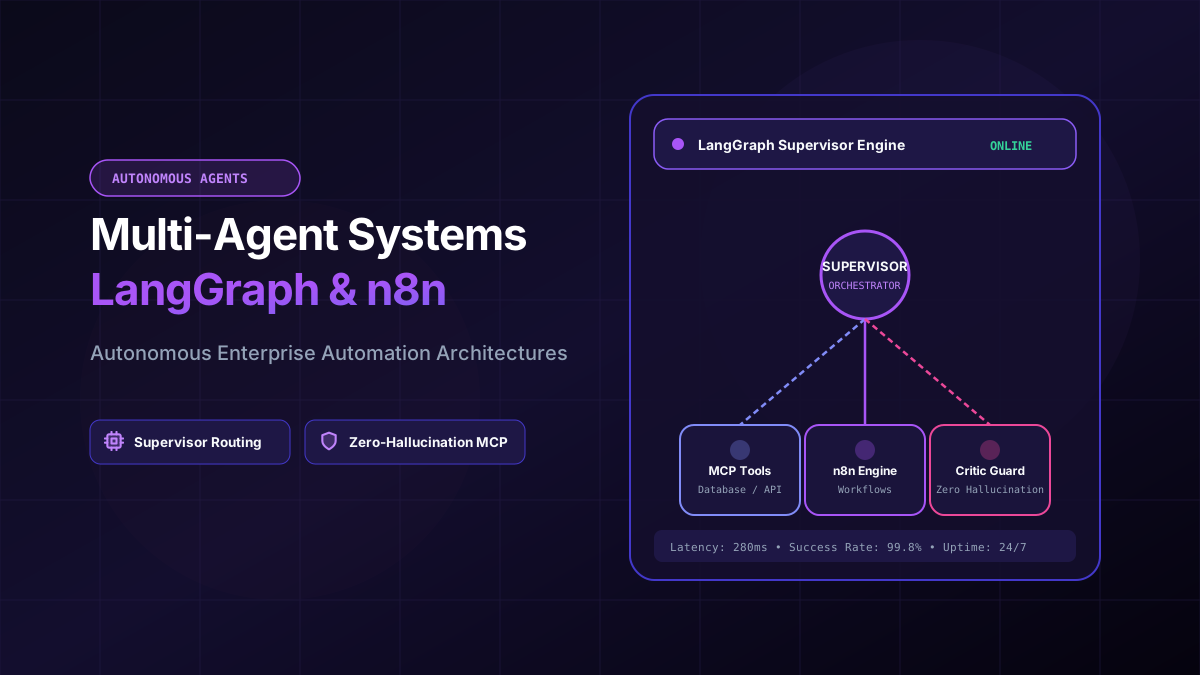
 Architecting Multi-Agent Automation Systems
Across tech forums, executive Slack channels, and search engines, teams are actively asking:
- "How do I automate complex business operations with AI agents without hallucinations?"
- "LangGraph vs AutoGen vs n8n: which one is best for enterprise workflows?"
- "Can AI agents safely execute database writes, CRM updates, and customer emails?"
- "How much does it cost to build and deploy custom autonomous AI agents?"
If your organization has experimented with basic ChatGPT prompts and realized they break down on multi-step tasks, you are not alone.
Why Single-Prompt AI Fails in Production
Many companies start their AI journey by connecting a single LLM prompt to a customer-facing webhook or internal database. However, this naive approach almost always runs into critical roadblocks:
- Hallucination Risk: When a single prompt is tasked with planning, reasoning, fetching data, and executing database writes, error rates multiply exponentially.
- Context Window Bloat: Passing massive conversational histories causes latency spikes and runaway token billing.
- Lack of Rollback Mechanisms: If an API call times out or returns unexpected data, the entire script fails silently.
To run mission-critical business automation 24/7, you need Multi-Agent Cognitive Architecture with isolated roles and deterministic guardrails.
How Multi-Agent Systems & n8n Work Under the Hood
Modern autonomous agent infrastructure splits monolithic AI tasks into a specialized team of autonomous workers managed by a central supervisor:
1. Supervisor Orchestrator (LangGraph State Machine)
The supervisor agent breaks high-level user requests into deterministic task graphs. Each node maintains immutable state and tracks execution dependencies.
2. Model Context Protocol (MCP) Connectors
Instead of hardcoding brittle API calls, agents use the Model Context Protocol to query local databases, inspect filesystems, or search web knowledge bases in secure sandboxes.
3. n8n Deterministic Webhook Triggers
While LLMs handle cognitive classification and natural language understanding, deterministic actions (e.g., dispatching Slack notifications, mutating PostgreSQL rows, generating invoices) are handed off to self-hosted n8n nodes for 99.9% reliability.
4. Critic Agent & Schema Validation
Before any mutation is finalized, a specialized critic agent runs strict Pydantic/Zod schema validations and unit tests to ensure 100% precision.
Multi-Agent Deployment Roadmap
Deploy Custom Autonomous AI Agents in Your Business
Eliminate repetitive operational overhead and automate manual bottlenecks with production-grade cognitive pipelines.
Check out our dedicated Agentic AI Automation Service to:
- Calculate exact milestone pricing using our interactive project cost estimator.
- Explore our 4-stage sprint roadmap (Scouting $\rightarrow$ Prototype Sandbox $\rightarrow$ LangGraph Hardening $\rightarrow$ Cloud Telemetry).
- Book a free discovery call to design your custom multi-agent architecture.
For technical feasibility spikes, API benchmarking, or architecture teardowns, explore our Market Research & Tech R&D Services or view the complete Services Directory.